
Both of my parents have now passed away, and it falls to the four of us siblings to find a home for innumerable collections. How could two elderly people have so many dishes? Plates? Crystal Fork Rests? Rocks? Shells? Postcards? Stamps? And most of all – books.
My youngest brother has taken on the largest share of the burden. Whenever he visits us in Massachusetts our group chat is inundated with photos of a wide assortment of items arrayed on the dining room table. “Who wants these nine cow milk pitchers? Speak now or they go to Savers tomorrow.” That kind of thing. I am fairly sentimental, so I have accumulated too many plates, statues, furniture, and – inexplicably – at least six chairs and four tables. I swear I did not ask for the ancient cane-seat chairs but my brother probably has proof that I indicated some interest.

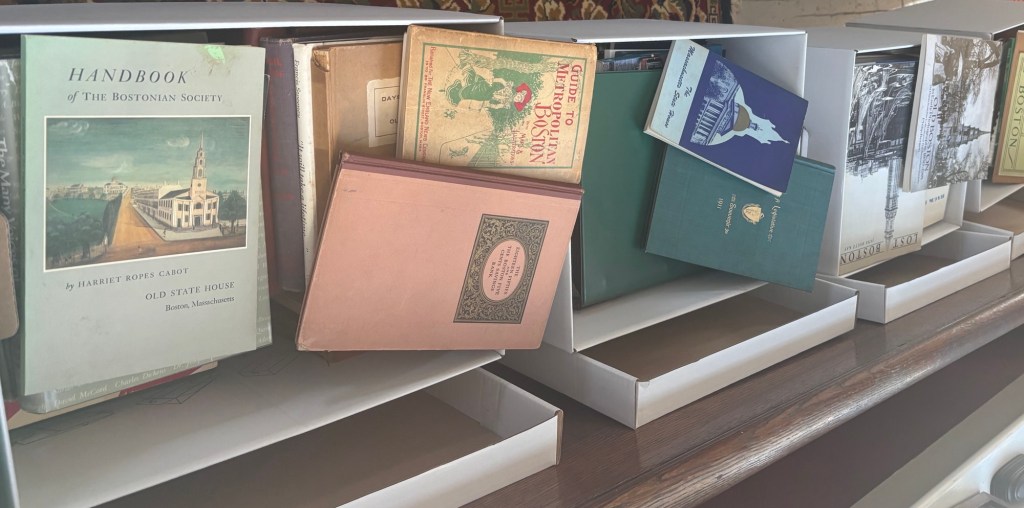
When my father died in 2016, my brothers estimated that there were over 10,000 books in the house. The job of getting them to the right home has also mostly fallen to the youngest. He saves them for people who might like them. He brings them to the local library, he takes them to consignment shops as a donation. When he asked about my dad’s books on Boston, I said I wanted to take a look. By the time I got home that day there were four bankers boxes on my porch. He wasn’t leaving anything to chance. Every time he comes home he finds more books about Boston.
I can’t bring myself to give them to the local library for the book sale. The City of Boston Archives and the Boston Public Library were polite but uninterested. So I decided to catalog them as a way of preserving their memory. This turned out to be a joyful project. The collection of about 160 items includes paperbacks, hardcovers, pamphlets, exhibition guides, maps, and other ephemera. For example:
- Water Supply and Work of the Metropolitan Water District (1900)
- Journals of the House of Representatives 1767-1768 (1949)
- The Metamorphoses of Scollay and Bowdoin Squares (1971)
- One Hundred Years of the Suffolk Savings Bank for Seamen and Others (1933)
- Centenary of the See of Boston (1908)
- The Eighteen Fifties and the Boston Five Cents Savings Bank (1926)
- Guide to Metropolitan Boston (1899)
- The Memorial History of Boston 1630-1880 (vol 1.) (1880)
- Red Line Extension NW Harvard to Alewife (1978).
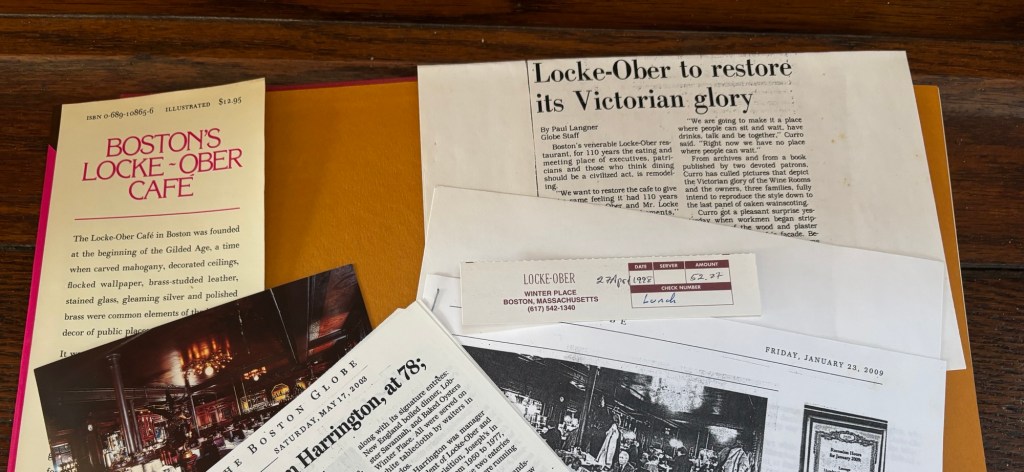
My father had a habit of saving magazine articles (often photocopied at the library) and including them in books on the same topic. My favorite example of this is a history of Locke-Ober, the posh Boston restaurant where women could not dine until 1970 (Boston’s Locke-Ober Café, 1978). Tucked inside were two news articles, a postcard, an obituary (we are Irish after all) and a receipt from a lunch he had there in 1998 ($52.27).
How about you? Do you keep books? Do you tuck things in them to save? Have you ever used a crystal fork rest (i.e. what should I do with the 8 that I now have)? Have you read Bill Weld’s Mackerel at Midnight? (If not you can have my signed copy.) What advice do you have for me – is there a home for this collection?
Let’s practice – mug of tea and a copy of Boston Ways High, By, and Folk (1957) in hand.
 Very Kate