
Recently, as I was pondering my long to-do list, I starting thinking about President Eisenhower. As one does. According to the former president, “What is important is seldom urgent, and what is urgent is seldom important.” The Eisenhower Matrix, later popularized by Steven Covey, purports to help us be more strategic about task prioritization.
I decided to experiment, creating the recognizable matrix of importance and urgency – do, decide, delegate and delete. I added a category below the matrix called the “LOOMING AREA”. So in theory, we should spent most of our time on items that are strategic and long-range, and finish, delegate or delete those that aren’t. Since all of my identified tasks were assigned to the LOOMING AREA, I began to categorize them as instructed by Eisenhower and Covey.
I counted six tasks that were important and urgent (“do”), 16 that were important, but not urgent (“decide”), two that were urgent but not important (“delegate”), and 12 that were not important or urgent (“delete”).
In what will be a surprise to no human working in late 2025, I had completed 100% of the “do”, and 100% of the “delegate” tasks (to whom am I supposed to delegate?). It is pretty clear that when something is urgent like filling out a time sheet or filing an expense report it gets done even at the expense of long-term planning. Fifty percent of the “delete” tasks had also been checked off. Is there really a manager out there who will just ignore these tasks?
So that leaves only 19% of the “decide” tasks completed. These are the important things that we have promised to do – presentations to draft, articles to write, staff to mentor, plans to develop – in other words, the things that create meaning. Only 19% complete.
The problem I have with this matrix is its oversimplification. Items feel like they are equally weighted – booking airfare for a trip and developing a performance improvement plan sit next to each other with boxes to check. But the matrix did show me – quite clearly – how much I am procrastinating.
So where is our time going? A colleague introduced me to the concept of “occupational hobbies.” These are the tasks that are routine, often mindless, and fit squarely in our skillset. They are often things than can and should be done by others in our organizations. Unless your occupational hobby is to read comments or scroll local social media sites, these tasks often add some value – just not at the level of the more strategic items. They also allow us to (gleefully) check a lot of boxes.

Common occupational hobbies include:
- Getting to Inbox Zero
- Reviewing staff memos for typos
- Filing emails into folders
- Updating HR policies
- Integrating collective bargaining agreements (research shows I am the only person who enjoys this task)
- Fixing broken links on websites
- Using fun new software to create maps and charts
- Developing creative PowerPoint templates
- Actual paper filing
- Creating a spreadsheet to track data that is already available in another source
- Organizing the books on your shelf
- Organizing your pen drawer (this really is a great task for boring Zoom calls).
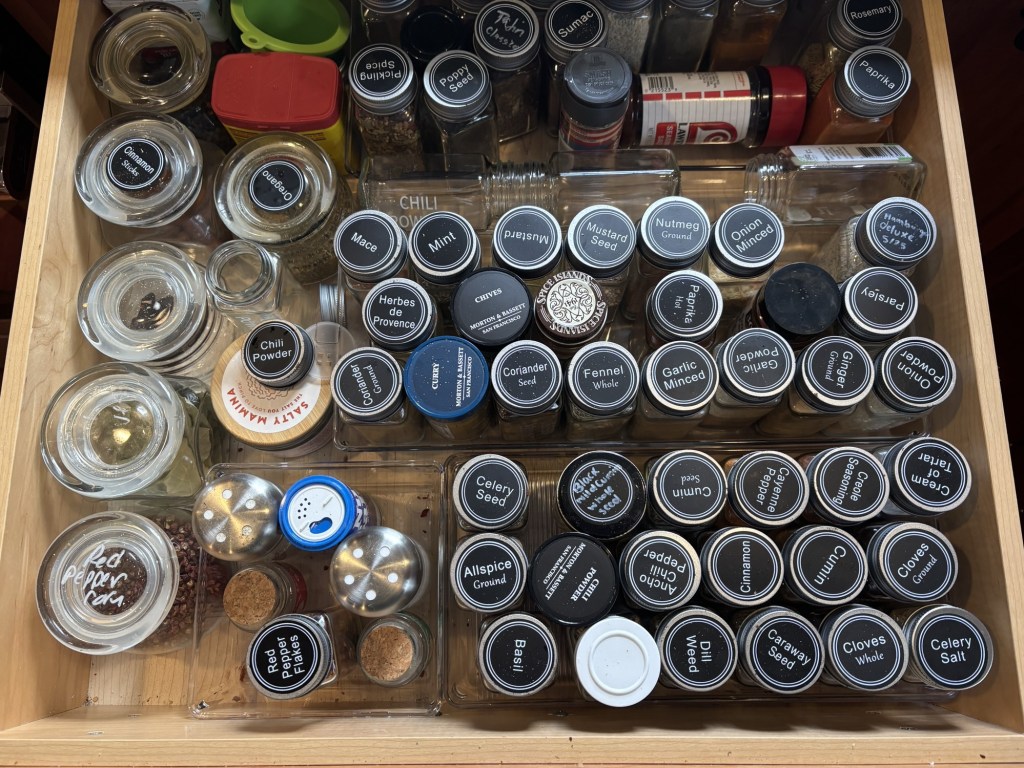
Now that I work from home, and no longer have HR policies to update, it is the spice drawer that calls my name when I should be learning how to use LinkedIn to better advantage. Far and away the thing I procrastinate most is this blog. It is my one creative outlet and I love it – when it’s done. So why I am procrastinating? My goal for 2026 is to really examine what I am doing to sabotage my efforts to do what I say I want to do – to actually do the important but not urgent tasks.
So how about you? Do you have a task management strategy that you swear by? What is your occupational hobby? By the way, that LOOMING AREA? It hasn’t gone away.
Let’s practice – devoting at least as much time next week to strategic projects as we do to our occupational hobbies. Once the spices have been rotated.

 Very Kate
Random notes:
Getting the contracts integrated is helpful to me. I’ve run into situations when there are three or more MoUs/MoAs and I’m much happier having everything together in “one place”.
Recently took one of the Monday holidays and spent the day at work triaging piles of paper. That made me happier (probably improved the reactions of visitors to my office).
I have a few important non-work projects. Some of them are “keep track and keep organized” and some of them are “shoveling snow” (there is an end once the snow stops falling (can you guess what I’m doing today) projects. If I can keep making progress, even incrementally, I’m in a better, less stressed state.
LikeLiked by 1 person